History of Computers
(BBC Documentary)

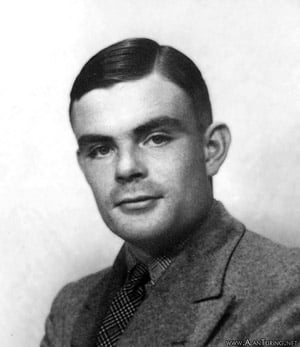 Computers were used simply because people needed help in their calculations. They used computers for census, for industrial purposes and for mathematical calculations. The first computers were tabulating machines used with punch cards. A man named Alan Turing invented a machine that involved in cracking German war codes. It translated codes used by the Germans and according to some, it helped on the victory against the Germans. Tuning also said that computers were not simply arithmetic machines. Sadly, Turing didn't get to see how computers have turned out because in 1954 he committed suicide.
The first commercial computer in the U.S was called UNIVAC (Universal Automatic Computer) from the Eckert-Mauchly Computer Company. However, it wasn't really successful. Eckert and Mauchly both faced a lot of problems that lead for their company to close. The new UNIVAC was introduced by Remmington Rand. It was first used on the U.S elections where Eisenhower won.
Computing-Tabulating-Recording Company (CTR) later known as IBM or International Business Machines started producing machines. Its main driver Thomas J. Watsons Sr. lead the company to its success. Watson is know for its company motto "THINK". Meanwhile in UK, the first commercial computer was called LEO I (Lyons Electronic Office I) made by J.Lyons and Co., one of UK's leading catering and food manufacturing companies in the first half of the 20th century.
The use of computers on factories and offices caused fear among the society. People thought computers are going to replace them on their jobs. The use of computers in public wasn't really an easy process.
 |
| Apple I (1976) by Steve Wozniak and Steve Jobs |
An American engineer named Douglas Engelbart invented the first mouse but didn't get that much attention. While on 1974, Attair 8800, the first commercially successful personal computer was released. It sold thousands in its first month of release. And on 1976, Apple's first computer was released by Steve Wozniak and Steve Jobs.

In 1960, Xerox 914 photocopier was introduced and became useful for offices. Xerox's Palo Alto Research Company (PARC) invented a bunch of useful stuffs. It helped a lot on the evolution of personal computers. Some of PARC's programmers were hired by Steve Jobs to institute a program that resulted in the Lisa.
First generation electronic computers used to fill up a room while personal computers are just placed on desks. First generation computers used vacuum tubes and tons of wires to work but personal computers only needed small chips to function. PCs were more graphical and fast than the first generation computers.
